Most businesses get SEO wrong. They chase traffic. They publish random blog posts. They wonder why leads do not come.
I have built SEO content strategies for multiple companies. The ones that succeed follow a system. The ones that fail treat SEO like a lottery ticket.
Here is the truth. Generating 1,000 leads per month through SEO content marketing is achievable. But you need the right strategy. You need to stop doing what everyone else is doing.
Start With the End in Mind
Before writing a single word, define what a lead means for your business. Is it a form fill? A demo request? A newsletter signup?
Most companies define a lead too broadly. They count every email capture as a win. That inflates numbers but does not grow revenue.
Read Also: Android Lock Screen Advertising: How to Stop Ads in 2026?
Focus on quality over quantity. A business with 1,000 website visitors and a 1% conversion rate generates 10 leads. Improve that conversion to 2.5% without adding traffic. You now have 25 leads. That is 150% more from the same effort.
The math changes when you scale. If you drive 40,000 visitors monthly and convert 2.5%, you hit 1,000 leads. That is the target.
Fix Your Conversion Problem First
Most businesses have a leaky bucket. They drive traffic. The traffic leaves without taking action. Fixing this is cheaper than driving more traffic.
Audit your high-traffic pages. Which pages get the most visitors? Which ones generate the most leads? Audit the pages most likely to influence leads, not just the pages that get traffic.
Add clear calls-to-action on everything you already own. Every blog post needs a next step. Every landing page needs a form. Every video needs a link.
Use lead magnets. Trade something valuable for contact information. Checklists, calculators, and templates work best. A simple PDF download converts better than a generic "contact us" form.
Apply the "micro yes" strategy. When SEO brings a user to your site, do not ask for an email immediately. Start with a small commitment. A click. A scroll. A view. Then ask for more.
Keyword Research That Generates Leads
Most keyword research focuses on volume. That is a mistake.
High-intent keywords drive higher conversions, even with lower search volume. A person searching "best CRM for small business" is closer to buying than someone searching "what is CRM."
Target bottom-of-funnel keywords first. These are searches like "price of X," "X versus Y," "buy X," or "X demo". These users are ready to act. They convert at higher rates.
Use long-tail variations. B2B buyers use specific, problem-oriented queries. "Wholesale vitamin C face masks" has lower volume than "face masks." But the buyer is more qualified.
Analyze competitor keywords. Find what your competitors rank for. Identify gaps. Target keywords they have missed.
Group keywords by intent. Not all keywords are equal. Informational keywords teach. Commercial keywords compare. Transactional keywords convert. Map each to the right content type.
Build Topic Clusters, Not Isolated Articles

Publishing separate articles for every keyword is outdated. Modern search engines evaluate topical authority. They look for content ecosystems, not isolated pages.
You Must Also Like: Push Notification Marketing Strategy for 2026: What You Want to Know?
Create pillar pages. These are comprehensive guides on broad topics. They cover everything a beginner needs to know.
Build supporting content. Write detailed articles on subtopics. Link them back to your pillar page. This builds topical authority.
Link internally between articles. Google rewards depth in a topic. Internal links show relationships between your content. They help search engines understand your expertise.
Cover one subject thoroughly. Do not publish 10 blog posts weekly on random topics. Publish fewer posts that go deeper. Become the go-to resource for your niche.
Map Content to the Buyer Journey
Different users need different content. A person at the top of the funnel wants education. A person at the bottom wants pricing.
Top of funnel (TOFU): Create blog posts, guides, and glossaries. Answer "what is" and "how to" questions. Capture email addresses with lightweight downloads.
Middle of funnel (MOFU): Create comparison pages, case studies, and calculators. Help prospects evaluate solutions. Prove your technical capability.
Bottom of funnel (BOFU): Create pricing pages, demo requests, and product documentation. Make it easy for ready buyers to take action.
Most businesses create too much TOFU content. They attract visitors but do not convert them. Balance your content across all three stages.
Create Content That Actually Converts
SEO content aims to attract organic traffic by providing valuable information that matches user search intent. But traffic alone does not pay bills.
Write for the customer's search, not your brand story. Customers do not care about your history. They care about their problems.
Use benefit-driven copy. Explain how your solution helps. Focus on outcomes, not features.
Include strong CTAs. Every piece of content needs a next step. Make it obvious. Make it easy.
Gate your best content. Put your most valuable resources behind forms. Whitepapers, industry reports, and templates work well.
Update and republish outdated content. Things get stale. Refresh old posts with new information. Republish them. This drives traffic without creating new content.
The Numbers You Need to Hit 1,000 Leads
Let us do the math.
Traffic required: If your conversion rate is 2.5%, you need 40,000 visitors monthly to generate 1,000 leads.
Content required: Companies that publish 11 or more blog posts monthly generate 3x more inbound leads than companies publishing 0-1 posts.
Time required: SEO content takes 3 to 6 months to produce meaningful results. Unlike paid ads, results compound. An article ranking in month 6 generates leads in month 18 and beyond.
Investment required: Content marketing costs 62% less than traditional marketing and generates approximately 3x as many leads.
Optimize for AI Search Visibility
Search is changing. AI overviews now answer queries directly at the top of search results. Studies estimate this affects 60 to 80% of informational searches.
Structure content to answer direct questions clearly. This trains search algorithms to view your brand as authoritative.
Create content that helps AI understand your fit for specific buyers. Be explicit about who you serve and what problems you solve.
Treat AI visibility as a new layer of lead generation strategy. It is not a replacement for SEO or conversion optimization. It is an addition.
Front-load your most valuable insights. Put the key information early. AI systems and readers both appreciate this.
Build a System, Not a Campaign
Most businesses limit digital marketing to three things: a website, SEO, and ads. But sales do not grow because there is no system.
Diagnose your starting point. Measure what is really working. Which channels bring leads? At what cost?
Create a repeatable process. Generate leads through a consistent system, not one-off campaigns.
Track the right metrics. Focus on leads generated, not just traffic or rankings.
Scale what works. Identify your best-performing content. Create more like it. Repurpose it across channels.
My Final Take
Generating 1,000 leads per month through SEO content strategy is realistic. But it requires discipline. You cannot publish random content and hope for results.
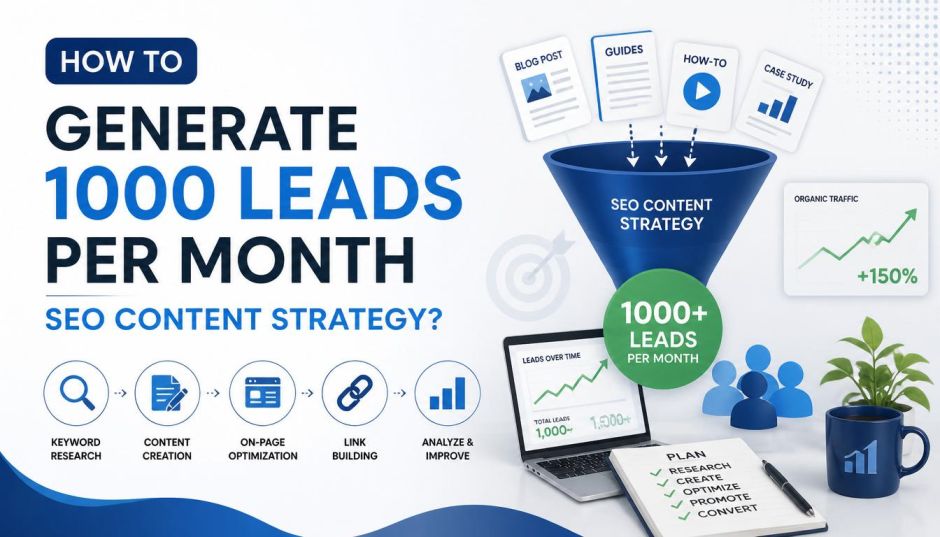
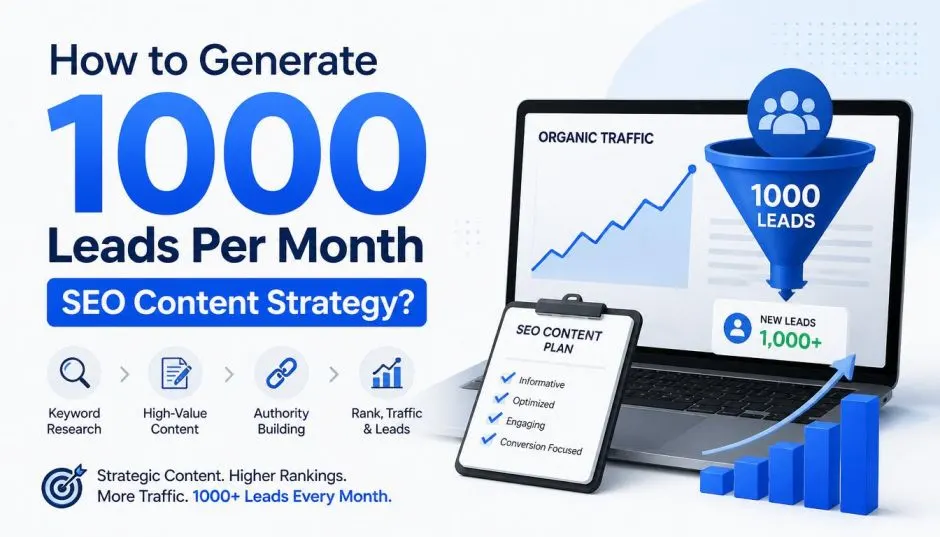
Start with conversion optimization. Fix your leaky bucket. Then drive targeted traffic through keyword research and topic clusters. Map content to the buyer journey. Create content that converts. Optimize for AI visibility. Build a system.
The businesses winning at SEO in 2026 are not the ones spending more. They are the ones who understood these shifts early and adapted.
Stop chasing traffic. Start generating leads.